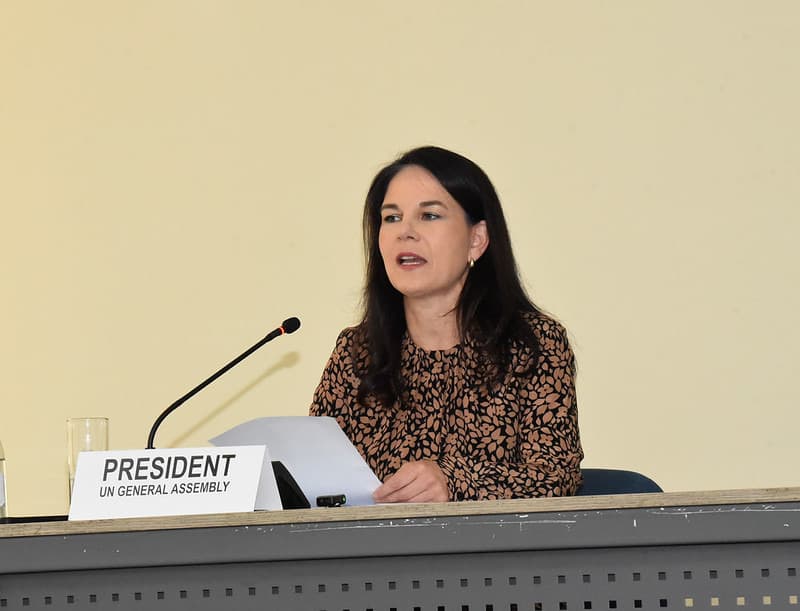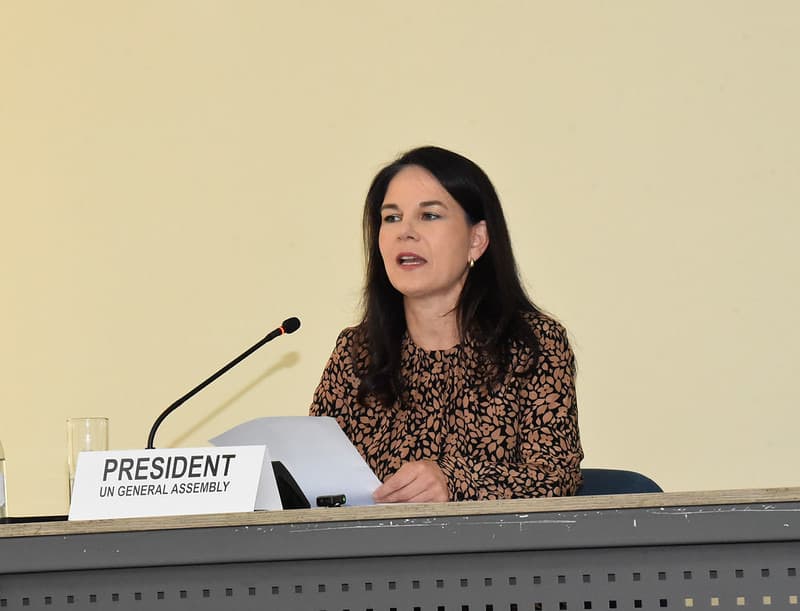
The United Nations needs "more Africa" in its halls of power, the President of the UN General Assembly, H.E. Annalena Baerbock, declared today, throwing her weight behind the long-standing demand for a permanent seat for African nations on the Security Council.
Speaking from the UN Office in Nairobi – the only UN headquarters located in the Global South – Baerbock described the continent as essential to the future of multilateralism.
"When some argue that the United Nations should return to the basics, I would say this," Baerbock said. "The basics are already on full display here in Kenya and across Africa. Peace and security. Human rights. Sustainable development. The three founding pillars of the United Nations are not abstract concepts. They are being advanced every day."
Responding to a question from a Kenyan journalist, Baerbock went further, describing the current exclusion of Africa from permanent Security Council seats as one of the "injustices of the path within the international system."
"This is one of the injustices of the path within the international system," she said. "The under-representation of the African continent and of the African states."
She noted that the call for reform is no longer coming only from Africa itself but from "other continents as well."
"We are at a critical moment in this reform debate," Baerbock said. "It is not only about lip service anymore. It is about delivery."
The President confirmed that the African Union has been working on a concrete proposal for an African seat, describing those discussions as "crucial." As President of the General Assembly, she has appointed co-chairs to lead discussions within the Intergovernmental Negotiations (IGN) process – the formal mechanism for Security Council reform.
She acknowledged that there is now "broad support for a permanent seat for African states."
However, she was careful not to promise quick results. The reform of the Security Council is notoriously complex, entangled with the future of the veto power.
"As you know as well, there are more urgent questions around the reform of the Security Council, for example with regard to the veto and the misuse of the veto with regard to peace and security," she said. "These questions are interconnected. It is not so easy to take these reform steps."
Nevertheless, she insisted that momentum for change is real and that under her presidency of the 80th session of the General Assembly, "we are trying to go a step further."
Baerbock then broadened the conversation beyond the Security Council, arguing that Africa's marginalization is not limited to one institution. She called for parallel reform of international financial institutions – the World Bank and the International Monetary Fund – where borrowing costs remain "way higher for many developing countries, for many African countries."
She noted that African nations have been leading the charge on several innovative global initiatives, including the "Compromiso de Sevilla" (Commitment of Seville) and the Doha Political Declaration on financing for development. African countries also played a leading role in advancing the "Pact for the Future."
"Already, Africa is helping to shape the future of multilateralism," Baerbock said.
She praised Kenya specifically for its leadership on renewable energy – the country has ambitiously targeted 100 percent renewable energy by 2030 – calling it "not simply a national success story" but "an example for the world."
Concluding her formal remarks, Baerbock invoked the words of Kwame Nkrumah, Ghana's first president, who addressed the General Assembly in 1960 – the "Year of Africa."
She quoted Nkrumah: "One cardinal fact of our time is the momentous impact of Africa's awakening upon the modern world."
Baerbock paused before adding her own coda: "That moment is no longer a prediction. It is a reality."