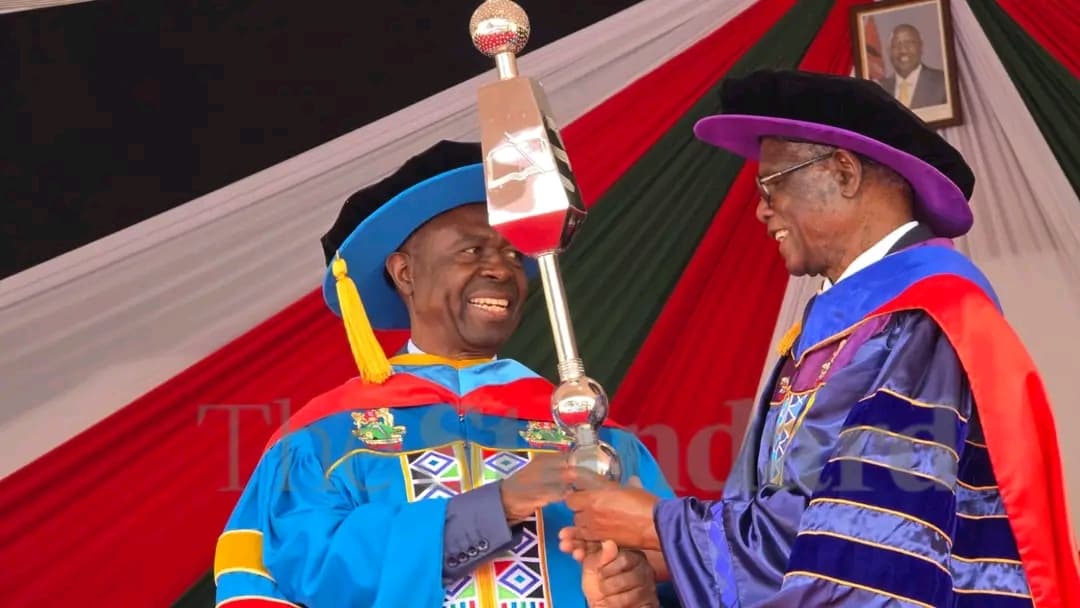
Kenyatta University’s new Vice-Chancellor, Prof. John Okumu, has called for universities to rethink how they train students, conduct research and deliver services as technology and the labour market continue to change rapidly.
Prof. Okumu said universities must move beyond traditional approaches and equip graduates with skills that enable them to compete for employment while also creating opportunities in an increasingly technology-driven economy.
Speaking during his installation as Kenyatta University’s seventh substantive Vice-Chancellor at the university’s Graduation Square on Friday, Prof. Okumu said his administration would focus on making the institution more responsive to technological developments, industry needs and emerging opportunities.
He said the changing environment in higher education required universities to strengthen innovation, research and partnerships while ensuring that academic programmes remained relevant to the needs of society and the economy.
“The world around us is changing rapidly and technology is redefining education and work where Artificial Intelligence is transforming knowledge production,” Prof. Okumu said.
He said Kenyatta University would need to adapt to these changes by strengthening digital systems, improving access to technology and creating an environment that supports innovation and research.
Prof. Okumu said his administration would also seek to strengthen the university’s relationship with industry, government and other partners to provide students with greater exposure to practical skills and emerging opportunities.
He said stronger collaboration with industry would help bridge the gap between university training and workplace expectations while creating opportunities for research commercialisation and technology transfer.
The Vice-Chancellor further pledged to expand research opportunities and promote multidisciplinary research aimed at addressing challenges facing society.
He said the university would focus on research in areas including health, agriculture, education, governance and sustainable development, while strengthening mechanisms for technology transfer and intellectual property protection.
Prof. Okumu also identified graduate employability as a key priority, saying universities should produce graduates who are not only seeking employment but are capable of creating opportunities.
“Our vision is to produce competent, ethical, innovative and resilient graduates who are not merely seeking employment, but are capable of creating opportunities,” he said.
He said achieving this would require universities to strengthen entrepreneurship and innovation programmes and expose students to practical experiences that can help them transition from academic life into the world of work.
Prof. Okumu also pledged to promote digital transformation across the university, including the adoption of digital learning systems, online applications and other technologies aimed at improving efficiency and accessibility.
He said the university would have to respond to growing competition for students, talent and research funding, as well as increasing expectations for relevance, innovation, accountability and measurable impact.
The new Vice-Chancellor also highlighted financial sustainability as an important part of his administration, saying the university would seek to diversify its revenue streams while maintaining financial discipline.
Prof. Okumu said the institution would pursue stronger partnerships with government, industry, development agencies and international organisations to expand opportunities for research, innovation and commercialisation.
He takes over the leadership of Kenyatta University from Prof. Paul Wainaina, having served the institution in various academic and administrative capacities.
Prof. Okumu, a professor of physics, holds a PhD in condensed matter physics from the University of Leeds in the United Kingdom and has served in several academic and administrative positions, including Deputy Vice-Chancellor, Academic.
As he assumed office, Prof. Okumu said his administration would build on the university’s existing achievements while positioning the institution to respond to the changing demands of higher education, technology and the labour market.
“I accept this responsibility with humility, determination and with great conviction that, working together, we can take Kenyatta University to greater heights of excellence, social impact and distinction,” he said.